Anxious Attachment: Why You're Always Waiting for It to Fall Apart — and How to Finally Feel Safe in Love
What Anxious Attachment Actually Is

Attachment theory was first developed by psychiatrist John Bowlby in the 1950s and 1960s, and extended through the landmark research of Mary Ainsworth, whose Strange Situation experiments in the 1970s identified distinct patterns in how children respond to separation from and reunion with their caregivers.
The anxious attachment style — also called anxious-preoccupied or anxious-ambivalent — develops in children whose caregivers were inconsistent. Not absent, not abusive in an obvious sense, but unpredictable: sometimes warm, available, and responsive, and sometimes distracted, emotionally unavailable, or simply not there in the way the child needed.
The child learns, from this inconsistency, that love is unreliable. That the people who matter most might be there one day and not the next. That closeness cannot be taken for granted and must therefore be actively worked for, monitored, and preserved.
The attachment system — the neurological system designed to keep us close to the people we depend on for survival — goes into a state of chronic activation. Always scanning. Always monitoring. Always working to secure the bond that feels perpetually at risk.
That pattern, laid down in childhood, does not automatically update when childhood ends.
How Common Is It?
Research by Hazan and Shaver — the psychologists who first applied attachment theory to adult romantic relationships — found that approximately 19% of adults have an anxious attachment style. That is roughly one in five people carrying this particular experience into every relationship they form.
A meta-analysis of 46 studies examining the relationship between attachment and anxiety found that anxious-ambivalent attachment showed the strongest association with anxiety disorders of all insecure attachment styles. A UK longitudinal study conducted during the pandemic — examining depression and anxiety weekly over five weeks — found that people high in attachment anxiety consistently experienced higher depression and anxiety than those with lower attachment anxiety, a finding that held across both periods of acute stress and more stable conditions.
Research also shows that anxious attachment doubles the risk of depression in adulthood, and that insecure attachment styles more broadly predict a threefold higher likelihood of developing PTSD following a traumatic event. These are not small effects. They represent a significant and measurable difference in how people experience their lives — driven substantially by a pattern that formed before they had any conscious choice in the matter.
What It Feels Like From the Inside
The pop psychology version of anxious attachment focuses on the behaviours: the texting too much, the need for reassurance, the clinginess. These things are real, but they are the surface expression of something much more profound happening beneath.
From the inside, anxious attachment feels like a specific kind of exhaustion.
The exhaustion of never quite feeling secure. Of being in a relationship that, by any objective measure, is going well — and still not being able to rest inside it. Of needing to check, and check again, and interpret, and monitor, in a way that you can see is excessive but that you cannot stop because the anxiety driving it is not coming from your rational mind.
It feels like loving someone and being terrified of them at the same time. Terrified not of who they are but of the possibility of losing them. Of what it would mean. Of the abandonment that the nervous system is convinced is only a matter of time.
It can feel like being too much — and knowing you are too much — and being unable to be any less. The need for reassurance that is temporarily soothed and then returns. The relief when they respond, followed quickly by the next wave of anxiety. The sense that the relationship is never quite solid beneath you, no matter how many times the other person demonstrates that it is.
It also, very often, feels like shame. Because the culture tells people with anxious attachment that they are needy, dependent, irrational. That if they just trusted more, worried less, calmed down, everything would be fine. As though the pattern were a choice rather than a nervous system response to a specific kind of early experience.
The Push-Pull Dynamic
Anxious attachment and avoidant attachment tend to find each other.
This is not accidental. The person who learned that closeness is unreliable and must be constantly pursued gravitates toward the person who learned that closeness is dangerous and must be kept at a careful distance. From outside, this looks like a mismatch. From inside, both nervous systems are doing something that feels profoundly familiar.
The anxious partner pursues. The avoidant partner distances. The pursuing intensifies the distancing. The distancing intensifies the pursuing. Both people end up confirmed in their deepest fears: for the anxiously attached person, that love is always about to be withdrawn; for the avoidantly attached person, that closeness always leads to suffocation.
This dynamic is not a personality incompatibility. It is two nervous systems, each shaped by early experience, running their survival programmes in a context that cannot fully contain them.
Understanding this does not resolve it. But it does change the question from what is wrong with me? to what did I learn, and can I learn something different?
Where Anxious Attachment Comes From — and Why It Isn't Your Fault
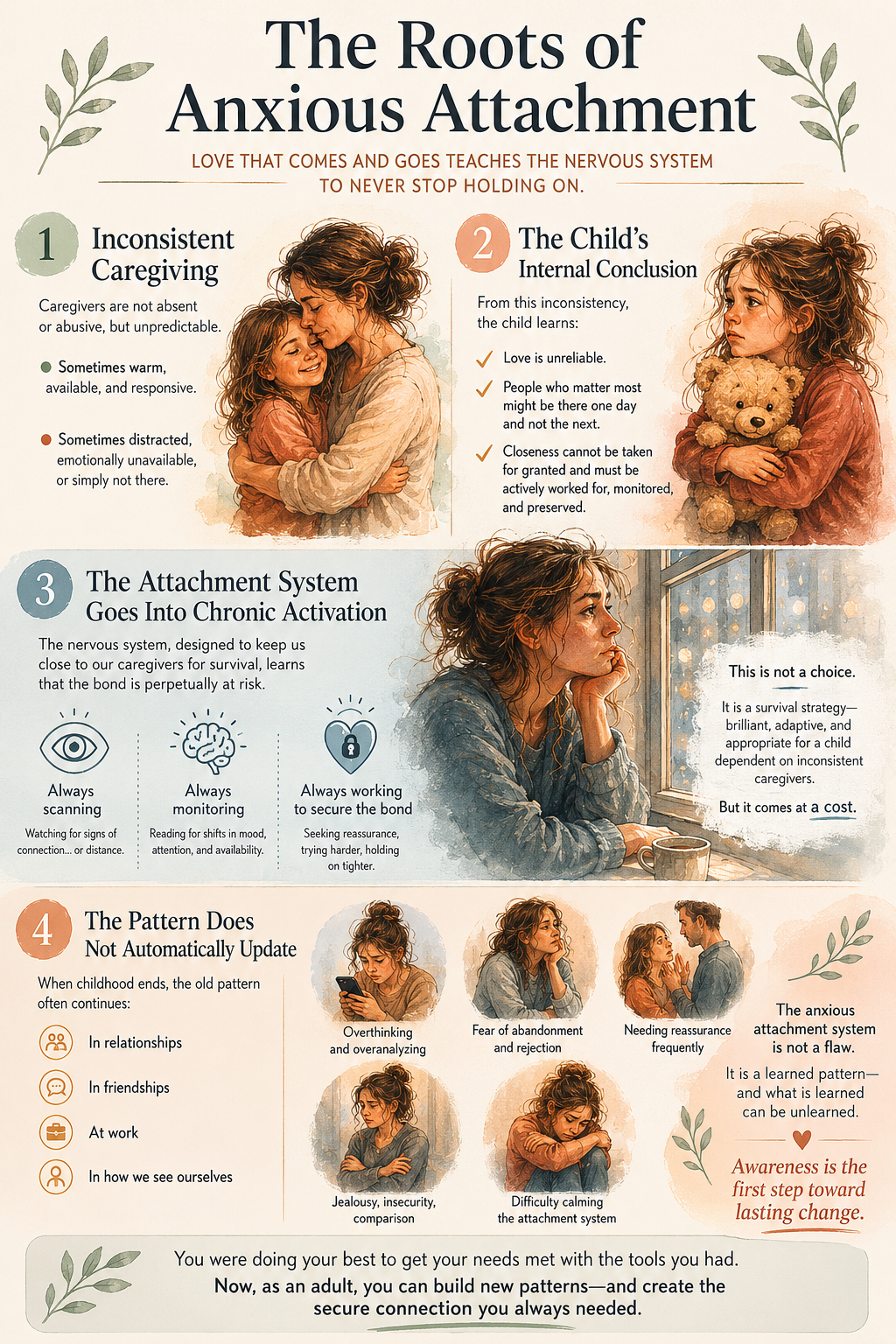
The attachment patterns formed in childhood are not choices. They are not evidence of weakness, neediness, or emotional immaturity. They are the nervous system's entirely logical adaptation to the caregiving environment it developed within.
The child with an inconsistently available caregiver — one who sometimes meets their needs warmly and sometimes doesn't, without the child being able to predict which will happen — develops a specific response: hyperactivate the attachment system. Seek more proximity. Protest more loudly at separation. Make the emotional signal stronger in the hope that this time, it will be reliably answered.
This was the right strategy for that environment. The tragedy is that the nervous system carries it into adulthood unchanged, applying it to adult relationships that often have nothing in common with the original caregiving environment — except that they involve love, and dependence, and the possibility of loss.
Anxious attachment is also associated with early experiences of trauma, inconsistency, emotional invalidation, and loss. Research on Adverse Childhood Experiences (ACEs) consistently shows that early adversity disrupts the development of secure attachment — with effects that are measurable across the full lifespan, in mental health, physical health, and the quality of adult relationships.
Why Understanding It Isn't Enough
This is something I say often, because it is one of the most common frustrations I encounter in people who come to work with me.
They have read the books. They know their attachment style. They can explain the anxious-avoidant dynamic with precision. They understand, intellectually, that the fear of abandonment is rooted in childhood and is not a rational response to their current relationship.
And they still feel it. Still check the phone. Still spiral when a message goes unanswered. Still find themselves devastated by things that they know, consciously, are minor.
This is not a failure of understanding. It is the entirely predictable consequence of the fact that anxious attachment is not stored in the understanding mind. It is stored in the nervous system, in the subconscious, in the body — in the parts of the brain that process threat and trigger survival responses faster than conscious thought can intervene.
You cannot think your way out of a nervous system response. You can only change it by working at the level where it lives.
How I Work With Anxious Attachment
IEMT — Integral Eye Movement Therapy
IEMT works directly with the neurological structure of the beliefs and memories that underpin anxious attachment. The conviction that love is temporary. That abandonment is inevitable. That you are only safe in a relationship when you are actively working to secure it. These are not conscious thoughts — they are subconscious operating beliefs, formed early and reinforced across every relationship since.
IEMT changes how they are stored in the brain, reducing the emotional charge they carry and interrupting the automatic patterns they drive. After IEMT, the same situations that previously triggered a full anxious response often begin to feel genuinely different — not through effort or willpower, but because the underlying programme has changed.
For the specific memories that established the pattern — the experiences of inconsistency, of reaching and not being met, of love that felt conditional or precarious — IEMT reduces their charge so they become part of a history rather than an ongoing instruction.
The BLAST Technique
BLAST addresses the accumulated fear and grief that anxious attachment carries — the fear of being left, the grief of relationships that have ended in the ways the nervous system always predicted, the exhaustion of decades of hypervigilance in close relationships.
For people who have experienced significant relationship losses, or whose early experiences included actual abandonment or inconsistent care, BLAST helps the nervous system complete the processing that it never had the safety or support to do at the time.
Hypnotherapy
Once the acute charge has reduced through IEMT and BLAST, hypnotherapy supports the installation of something the anxiously attached person has often never experienced: a genuine, embodied sense of security. Not as a performance or an affirmation, but as something that is felt from inside — a new baseline from which relationships can be approached with genuine presence rather than chronic fear.
What Secure Attachment Actually Feels Like
Many people with anxious attachment have never experienced a securely attached relationship — either in childhood or in adulthood. Which means they may not have a clear internal reference point for what it actually feels like to be in a relationship without the constant low-level fear.
It feels like being able to be present. Being in a good moment and actually being in it, rather than simultaneously bracing for it to end. Being able to tolerate the ordinary distance of two separate people — the partner who is tired, or quiet, or needs time alone — without that distance triggering alarm.
It feels like trust. Not blind trust, not the trust of someone who has never been hurt, but the trust of someone whose nervous system has learned, through experience, that closeness is survivable and that they will be okay regardless of what happens.
This is available. It is not just for people who were lucky in childhood. It is something the nervous system can learn — with the right kind of help.
UK Resources for Relationship and Attachment Support
Relate — relationship counselling across the UK: relate.org.uk. Helpline: 0300 100 1234
Mind — information on mental health and relationships: mind.org.uk
Samaritans — if you're struggling and need to talk: 116 123, available 24/7
BACP — find a trauma-informed therapist: bacp.co.uk
Frequently Asked Questions
Is anxious attachment a mental health condition? It is not a clinical diagnosis, but it is a recognised pattern with significant, documented effects on mental health, relationship quality, and physical wellbeing. Research consistently links anxious attachment to higher rates of anxiety disorders, depression, and PTSD. It is worth taking seriously and worth addressing with appropriate support.
Can anxious attachment change in adulthood? Yes. Attachment styles are not fixed personality traits — they are learned patterns, and the brain retains its capacity to learn new patterns throughout life. Research on attachment-based therapy shows that significant movement from insecure to more secure attachment is possible with the right therapeutic approach. The key is working at the level where the pattern lives — the nervous system and subconscious — rather than trying to manage it cognitively.
I'm in a relationship with someone avoidant. Is it always going to be this painful? Not necessarily — but both people's patterns need to be understood and addressed for the dynamic to genuinely shift. Understanding the anxious-avoidant cycle is the beginning. Addressing the underlying nervous system patterns in each person is what actually changes the experience of the relationship.
Why do I keep attracting avoidant partners? Because the nervous system tends to recreate what is familiar, and because the initial pull of an emotionally unavailable person replicates the early experience of inconsistent caregiving in a way that feels, paradoxically, like home. This is not a character flaw or poor judgement — it is an unconscious nervous system pattern, and it is one of the things that shifts most clearly in therapeutic work.
I feel ashamed of how anxious I am in relationships. Is that normal? Extremely common, and important to address directly. The shame is often more painful than the anxiety itself. Anxious attachment was not a choice — it was the nervous system's best available adaptation to an environment that didn't reliably meet its needs. There is nothing to be ashamed of. Understanding where the pattern comes from is the beginning of being able to respond to it with compassion rather than judgment.
Do you work with couples as well as individuals? My primary work is with individuals — addressing the attachment patterns and underlying nervous system responses that each person brings into their relationships. Many clients find that shifts in their own attachment patterns produce significant changes in their relationships without the partner being in the room.
You Deserve to Feel Safe in Love
Not constantly waiting for it to end. Not monitoring, scanning, and bracing. Actually safe — in a way that is felt rather than just decided.
That is possible. Start with a conversation.
Book Your Free 30-Minute Chat →
Or download the free A–Z Trauma Guides — including guides on abandonment, trust, shame, and your healing journey.
